Tour Itinerary
CHINA
IMPERIAL FOUNDATIONS
Day 1: Arrival in Beijing
- Arrival in Beijing with KLM. After arrival formalities, transfer to Beijing Rong Courtyard Boutique Hotel. This hotel was chosen for being located in the middle of the Hutongs in the old city of Beijing.
- From here you can walk and discover easily The imperial city of Beiing.
- Beijing has transformed from an old city with hutongs into a dynamic metropolis. China still has a one-party system, and you will notice government vehicles receive priority everywhere.
- The days in Beijing are completely free and you can get the feeling of one of the most important cities of the world rooted in a tradition going back into the early dynasties of China.
Days 2–3: Beijing | Independent Exploration
Explore Beijing at your own pace while gently acclimatizing to Asia. Visit famous landmarks such as:
- Tiananmen Square, one of the largest public squares in the world
- The Forbidden City, the political and ceremonial center of China for nearly 500 years
- A visit to China is not complete without climbing the Great Wall. A recommended section is Mutianyu, located about 45 kilometers outside Beijing. This part is not overly touristy, easy to walk, and offers phenomenal views. The oldest sections date back to around 550 AD, while newer parts date from the 14th century.
- In the evening, it is fun to visit Beijing’s night markets, where a wide range of delicacies is sold—from fried seahorses and scorpions to snake soup. Another option is attending a Peking Opera performance. Every evening, you can enjoy shows filled with colorful costumes, elaborate makeup, and acrobatic feats.
- Be sure to set aside a morning or afternoon to wander through Beijing’s hutongs—the traditional residential neighborhoods with narrow alleys and single-story houses. Here you experience the vibrant street life of local residents. End your walk at Tiananmen Square to see Mao Zedong’s portrait.
Day 4: Beijing → Xi’an (High-Speed Train)
- Enjoy your final morning in Beijing. In the evening, transfer to the railway station for the high-speed train to Xi’an.
- Your soft-sleeper tickets and the required Tibet Travel Permit will be delivered to your hotel. These permits are essential and can only be applied by a licensed Tibetan tour operator two week before your tour.
Day 5: Arrival in Xi’an
- Arrival in Xi’an, once known as Chang’an, capital of China for over a thousand years.
- Transfer by taxi to Puyuan Laoyangfang Hunyuan Guest House. The remainder of the day is free to explore the city’s lively squares, open-air restaurants, and evening fountains.
- Xi’an is the starting point of the Silk Road and has preserved much of its early glory. Here, you will find China’s oldest mosque and many Muslims who are descendants of ancient silk traders.
- Xi’an is famous for the Terracotta Army, but modern Xi’an is also worth exploring, with its wide boulevards and the “new” old city walls perfect for walking. The city embodies a mix of old traditions and modern Chinese life, with squares where people gather peacefully.
- The city is far less hectic than Beijing. People practice Tai Chi or chat calmly in the streets. In the evening, streets are often lined with red lanterns where people eat together. Food is a highlight in this hedonistic city, where ancient tradition and modern Chinese energy merge.
Day 6: Terracotta Army
- Visit the Terracotta Army, one of the greatest archaeological discoveries of the 20th century. It consists of more than 9,000 statues of soldiers, chariots, and horses placed in the mausoleum of China’s first emperor. Created in the 3rd century BCE, these life-sized figures were buried to guard the tomb of Emperor Qin Shi Huang, the first emperor to unify China.
- The rest of the day, explore Xi’an independently. It is highly recommended to walk through the Muslim Quarter, climb the Drum Tower for beautiful views of the city, or take a cycling tour of approximately 12 kilometers along the city wall dating back to the Ming Dynasty, which encircles the old city in a square.
- Another masterpiece worth visiting is the Wild Goose Pagoda, dating from the Tang Dynasty and a marvel of Buddhist architecture. It is also highly enjoyable to attend one of the spectacular Tang Dynasty performances. Through song, music, dance, and elaborate costumes and sets, the Tang period (618–906) is brought back to life. The dances are reconstructed based on ancient Tang-era documents.
Day 7: Xi’an → Lhasa (High-Speed Train)
- Board one of the world’s most extraordinary train journeys, crossing the vast Tibetan Plateau, often called “the Roof of the World.”
- The train passes permafrost zones, grasslands, and snow-covered passes before reaching Lhasa.
- Overnight on the train in a soft sleeper.
TIBET
THE SPIRITUAL PLATEAU
Concerning Tibet Permits:
Individual travellers are only allowed to enter Tibet with specially issued Tibet permits. These permits are issued exclusively by the Chinese authorities to registered tour operators within China and are based on a fixed itinerary.
For this reason, individual travellers require a tour operator in order to obtain these permits.Typically, it takes about two weeks for a tour operator to apply for and receive the permits.
Day 8: Arrival in Lhasa | Acclimatization
- Arrival in Lhasa, situated at over 4,000 meters above sea level. For centuries, Lhasa has been the spiritual and political heart of Tibet. Transfer to Shambhala Palace Hotel.
- This day is dedicated to rest and acclimatization. Altitude-support medication is available at pharmacies and the Tibetan Medical Center.
- Gentle walks through the old city may include a visit to Jokhang Temple, founded in the 7th century or enjoy a beautiful walk along the Barkhor and Lingkhor circuits.
Day 9: Potala Palace & Lhasa City Walk
- Visit the iconic Potala Palace, a UNESCO World Heritage Site and one of the most important symbols of Tibetan Buddhism. It is a 13-story fortress that dominates the entire city. The palace was built in the 7th century during the reign of King Songtsen Gampo and covers an area of 41 hectares. The 13-story building consists of white and red palaces with 1,000 rooms, including bedrooms, study rooms, stupas, and monk quarters. It is the headquarters of the Dalai Lama and has served as the home of each successive Dalai Lama. It is a treasure of traditional Tibetan culture.
- Afterwards, visit the Norbulingka Palace, the summer residence of the Dalai Lamas since the mid-18th century.
- Beyond the Potala Palace, Lhasa is filled with historic buildings and lively streets. A walk around the Barkhor area is always worthwhile, offering a fascinating glimpse into local life and tradition.
- You may also choose to visit the School for the Blind, founded by Sabriye Tenberken. The school was established in response to the high rates of blindness among nomadic children, often caused by constant exposure to thick smoke inside traditional tents. Visiting the school offers a meaningful insight into both the challenges and resilience of life in Tibet.
- Along the way, you may encounter small groups of young nomads performing prostrations (laying flat on the ground and rising again) as part of long pilgrimage journeys to distant sacred sites.
Recommended reading: My Path Leads to Tibet: The Inspiring Story of How One Young Blind Woman Brought Hope to the Blind Children of Tibet
Day 10: Samye Monastery
- Enjoy a full-day excursion to Samye Monastery, the first Buddhist monastery in Tibet. Travel by Land Cruiser with an experienced guide, passing through scenic countryside and traditional Tibetan landscapes along the way.
- Founded in the 8th century under King Trisong Detsen, Samye marked the formal introduction of Buddhism to Tibet. It was destroyed during the Cultural Revolution and was later rebuilt after 1988.
- Return to Lhasa the same day and stay overnight at your hotel. The following day, you will either fly to Kathmandu as part of the shortened tour, or prepare for a five-day overland journey via Gyantse, Shigatse, and Old Tingri, traveling by Land Cruiser across the Himalayas.
Day 11: Lhasa | Free Day
- A free day to explore further or rest before the Himalayan crossing.
Overland Himalayan Crossing
25-day version only
Day 12: Lhasa → Gyantse
- Depart Lhasa, cross the Kamba La Pass (4,794m), visit the stunning Yamdrok Lake, view the Karola Glacier. Arrive in Gyantse and explore the Palcho Monastery and Kumbum Stupa.
- Spend the evening in Gyantse, a very traditional featuring an old fort and several pleasant local restaurants.
Days 13: Gyantse → Shigatse
- Short scenic drive through the Nyangchu Valley to Shigatse, Tibet's second-largest city. Visit the magnificent Tashilhunpo Monastery, the seat of the Panchen Lama .
- Arrive in Shigatse, home to many important historical sites, including the former monastery of the Panchen Lama. Along the way, enjoy landscapes dotted with yak herds.
- Overnight stay in Shigatse.
Day 14: Shigatse → Rongbuk/Everest Region
- Drive via Shegar (New Tingri), cross the Gawula Pass (5,200m) for a panoramic Himalayan view. Continue to the Rongbuk Valley for sunset views of Mount Everest.
Day 15: Everest Region → Gyirong
- View Everest sunrise, then drive west towards the border. Enjoy views of Peiku Tso Lake and Mt. Shishapangma. Descend to the lower, greener altitude of Gyirong Town near the border
Day 16: Gyirong (Tibet) → Kathmandu
- Cross the Gyirong/Rasuwa Gadhi border. Complete immigration formalities. The drive from the border to Kathmandu goes through deep valleys and lush landscapes
- On the Nepal side, your local guide will be waiting with a jeep to transfer you to Kathmandu
NEPAL
VALLEY OF LIVING TRADITIONS
Day 17: Kathmandu
Kathmandu is a melting pot of different cultures. Ancient traditions such as those of the Newars blend with Indian Sikhs and Tibetan refugees. At certain times of the year, you will encounter remarkable sadhus on almost every street corner, on their way to an ice-cold lake to take a purifying bath.
Kathmandu, of course, also has modern aspects: heavy traffic and tuk-tuks. Fortunately, the old city center is almost traffic-free and accessible only by rickshaws. Vendors selling salted lemon soda stand next to boys trying to sell boiled eggs. Here and there, a last weary cow drags itself through the traffic in search of something to eat.
- You can wander endlessly through the many narrow streets of Kathmandu. In the immediate surroundings of the city, you can take short or longer hikes. Powerful rivers flow through the area, making rafting a great option as well.
- Stay at Hotel Thrive – A Tropical Courtyard
Days 18-21: Kathmandu Historical Valley Walk
The Kathmandu Valley offers a wonderful cultural experience. You will go on a four-day trek along the edges of the Kathmandu Valley, passing ancient towns and rice fields.
Visit the ancient trading towns and end the walk in Namo Buddha, where you will be picked up by a Land Rover and transferred to your hotel in Kathmandu
- You will visit the Namobuddha monastery and finish in Panauti, a charming trading town.
- The daily walks last between three and five hours, making them easy to manage. They are not very steep, but good hiking shoes are essential.
Day 18: Changunarayan → Nagarkot (Walking Day)
- Kathmandu to Changu Narayan by land rover with Guide, then walking to Nagarkot.
- Changu Narayan is a beautiful temple complex and a perfect place to relax. The complex dates back to the 4th century AD and features exquisite sculptures, including sculptures of the Hindu god Vishnu as well as a Malla king and queen.
- After visiting the temple, you continue on a walk featuring various cultural sights and spectacular views over the valley—one of the reasons this trek is so popular. The walk takes about 3 hours, passing through Chhetri villages and green rice terraces to Nagarkot. From here, you enjoy a stunning panorama stretching from the Annapurna Himalaya in the west to the Khumbu Himalaya in the east.
Day 19: Nagarkot → Dhulikhel (Walking Day)
- An easy walk from Nala to Dhulikhel via Banepa, a historic town. Banepa was a small kingdom for about 10 years starting in 1880.
- Continue to Dhulikhel, an ancient trading town on the Tibet–India route.
Day 20: Dhulikhel → Panuti (Walking Day)
- This day begins with a 30-minute walk to Devisthan, a small temple that offers a beautiful viewpoint of the Himalayas.
- Continue on a 4-hour walk to Panuti, a charming medieval town renowned for its valuable Newari architecture.
Day 21: Panuti → Khopasi → Kathmandu (Walking & Transfer)
- Walk to the town of Khopasi.
- Balthali Village: A 1-hour walk from Khopasi, involving a short but steep ascent to a plateau.
- Namo Buddha: A more substantial 2–3 hour walk from Khopasi, passing through villages such as Sanjyal and Thumki Danda. Along the way, you pass rice fields, encounter different ethnic communities, and always enjoy views of the Himalayas in the background.
- The walk from Khopasi to Namo Buddha is not just a journey through Nepal’s natural beauty, but also a cultural odyssey that connects you with centuries-old traditions and pristine landscapes. Along the tranquil trails leading to Namo Buddha, every step reveals a new facet of Nepal’s allure.
- Later in the afternoon, transfer back to Kathmandu.
Wildlife & India Boundary
Day 22: Flight to Nepalgunj
- Fly from Kathmandu to Nepalgunj, then drive by jeep to Bardia National Park (approximately 80 km), entering Nepal’s wild western lowlands. Stay at Bardia Forest Resort Hotel for three nights.
- During these days, a dedicated Nepal guide will accompany you on walks in the park and finally bring you to the India border.
- Bardia National Park was once a royal hunting reserve and now is one of Nepal’s most pristine wilderness areas.
Days 23 and 24: Enter The World of Tigers and Elephants: Bardia National Park
- This spetacular national park is something you can find only in Nepal.
- The tiger population is growing, along with leopards, and experienced guides know where to find them.
- The park offers wildlife in its purest form. Maintaining such a vast park near local settlements is a challenge, as the animals can sometimes wander beyond the boundaries. Yet the park not only continues to exist, it continues to expand—and it is very different from an African savanna-style nature reserve.
- A haven for a wide variety of wildlife, the park was originally established to protect the diverse ecosystems of the region and to conserve tigers and their prey. Since then, it has grown into one of the finest national parks in Nepal. Lush, dense forests, savanna, and riverine woodlands are home to an extraordinarily rich variety of flora and fauna.
- The park features a wide range of habitats, from dry upland hills to pockets of grassy plains. This diversity supports an impressive array of species with diverse needs.
- Most of the park is covered in subtropical forest, predominantly sal trees (approximately 70%), complemented by a balanced mix of grassland, savanna, and riverine forests. Altitudes range from 152 metres in the Terai lowlands to 1,441 metres at Sukamala on the crest of the Churia Range.
- Bardia National Park has the largest tiger conservation area in Asia, and its tiger population has increased significantly in recent years. As a result, Bardia was awarded the WWF TX2 Award in 2022 for doubling its wild tiger population since 2010—one of the most ambitious conservation goals ever set for a single species. In 2019, the park was also listed among the top sustainable destinations in the Asia–Pacific region.
Day 25: Return to Nepalgunj and Lucknow
- Transfer back to Nepalgunj and preparation for the onward journey to Lucknow as the final destination, followed by the train to Delhi.
Day 26: Lucknow (India) – End of the Tour
- Steeped in history, Lucknow blossomed into a city known for its architectural splendour and cultural diversity under the Nawabs of Awadh, especially the visionary Asaf-ud-Daula, who reigned from 1775 to 1797. The magnificent monuments of Lucknow showcase a fusion of Mughal, Persian, and British influences.
- End of the tour. Guests continue their journey independently by train to Delhi, India. More than 30 trains run daily between Lucknow and Delhi. The Vande Bharat Express and the IRCTC Tejas Express are the fastest, with journey times of around 6 hours and 25 minutes.
PRICES
per person, based on 2 traveling together
- 26-day Imperial Journey: €4,950 pp
- 21-day Shortened Journey: €3,750 pp
International flights (Amsterdam–Beijing / Delhi–Amsterdam with KLM*) are approximately €1,000, booked well in advance.

Included
- All hotels (3- or 4-star) throughout the entire period. Mostly 4-star boutique-style hotels with a strong personal touch.
- All breakfasts in the hotels.
- Special Tibet Permits to enter Tibet.
- Train tickets in soft sleeper: Beijing to Xi’an.
- Soft sleeper train: Xi’an to Lhasa.
- Excursion to Samye Monastery in a Land Rover with private guide and driver.
- Private guided visit of the Potala Palace in Lhasa.
- 5-day Land Rover tour from Lhasa to Kathmandu over the Himalayas with a private guide and driver or flight tickets from Lhasa to Kathmandu.
- Walking tour in Kathmandu Valley including hotels and private guide.
- Flight from Kathmandu to Nepalgunj.
- Transportation in Land Rover with guide to Bardia National Park.
- Excursions in Bardia National Park.
- Transportation in private Land Rover to Lucknow train station (India).
- Endpoint: Lucknow.
- Guests arrange their own train tickets from Lucknow to Delhi (approximately 6 hours).

Excluded
- Any meals other than hotel breakfasts.
- International flights and transport to/from international airports.
- Tips.
- Visa for China (not required in 2026).
- Changes to the itinerary or excursions not mentioned.
- Travel insurance.
Highlights
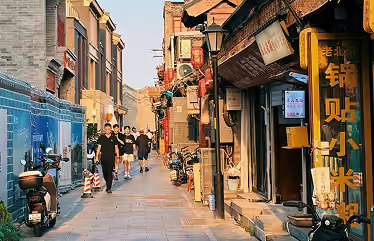
Beijing & the Hutongs
The hutongs date back over 700 years and housed officials, craftsmen, and scholars serving the imperial court. Each courtyard was designed according to principles of feng shui, reflecting harmony between family life and the cosmos.
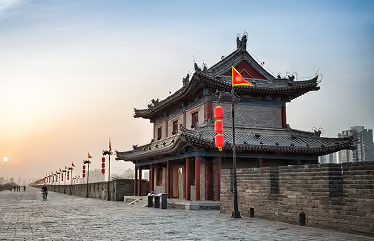
Xi’an & the Silk Road
For centuries, Xi’an connected China to Central Asia, the Middle East, and Europe. Silk, spices, religions, and ideas flowed through the city, shaping Chinese culture far beyond its walls.
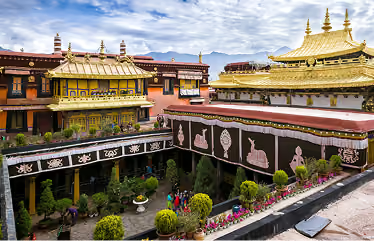
Jokhang Temple
Jokhang is considered the most sacred site in Tibetan Buddhism. Pilgrims from across the Tibetan world travel here, often after months or years of prostrations.
Samye Monastery
According to tradition, Padmasambhava subdued local spirits to allow Samye’s construction. The monastery was destroyed during the Cultural Revolution and rebuilt after 1988.
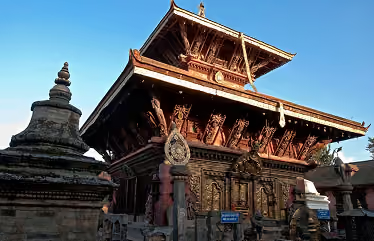
Changu Narayan
This UNESCO-listed site contains some of Nepal’s oldest stone inscriptions and sculptures, offering insight into early Hindu art in the Himalayas.
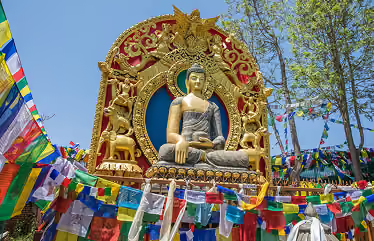
Namobuddha Legend
According to legend, a former incarnation of the Buddha sacrificed himself to save a starving tigress and her cubs — a cornerstone story of Buddhist compassion.
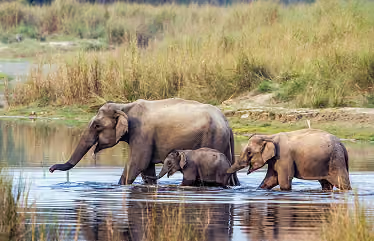
Bardia National Park
The National Park is the home to: bengal tigers, elephants, leopards, rich birdlife, and much more.